Gout sufferers must manage their levels of uric acid. So pain relief is usually a separate issue. But, some gout patients worry that their pain relief drugs might interfere with their uric acid levels.
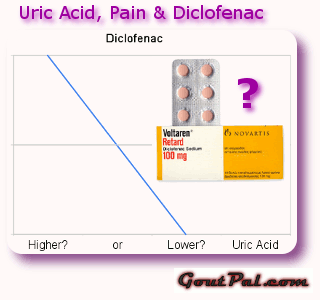
Diclofenac (usually sold as Voltaren) is especially feared. But is this another gout myth? Read on to see why this gout story came about. Then, why this gout myth is difficult to disprove.
Visceral Gout
There have been widespread diclofenac problems in the Indian subcontinent. Because huge numbers of vultures died from a disease labeled visceral gout. The vultures contracted this disease as a result of feeding from the corpses of cattle treated with diclofenac. Meteyer et al. [1] report:
Diclofenac, a nonsteroidal anti-inflammatory drug (NSAID), has caused sustained population declines in Gyps vultures of Pakistan, India, and Nepal.
Visceral gout describes a form of gout that affects the organs (viscera) of the mid-body [1]:
In addition to the kidney, uric acid crystals were seen most commonly in liver, spleen, lung, and heart, but were also noted in skin, adrenal gland, and parathyroid gland.
In the vultures studied, the visceral gout is secondary to kidney problems caused by diclofenac poisoning. Visceral gout, as opposed to articular gout (gout in the joints), appears not to affect humans.
However, this still leaves the question: can diclofenac raise uric acid levels?
Diclofenac & Uric Acid
Diclofenac is a commonly prescribed anti-inflammatory treatment for gout pain, but there is not much research into its effects on uric acid in humans.
I’ve found two studies that indicate that diclofenac has no effect on uric acid:
- Jelić-Ivanović et al.[2] studied the effects of 5 anti-inflammatory drugs on uric acid and 11 other blood components. They found that diclofenac had no effect on uric acid – the only effect is to raise urea, which increased significantly in the first 2 weeks of the trial, but returned to normal during the next 10 weeks. The only drug in this study that affected uric acid was ibuprofen, which lowered uric acid. Though only 8 ibuprofen taking subjects were measured, the average uric acid level fell from 5.35 to 3.86 mg/dL.
- Al-Arfaj et al.[3] studied the effects of 5 different drugs (unfortunately not including ibuprofen). Interestingly, they were investigating the combined effects of these drugs with fasting. The fasting experience showed increased uric acid after 10 days of fasting, falling back to slightly below the starting point after 15 days. This pattern repeated across all drug groups and the control. Diclofenac showed a very slight uric acid increase, deemed to be insignificant.
The conclusion from these 2 studies is that diclofenac has little or no effect on uric acid in humans. However, the first study brings into question some tests results.
Diclofenac & Blood Tests
Prior to reporting that diclofenac had no effect on uric acid, Jelić-Ivanović et al had published previous investigations into the effects of drug on laboratory tests[4]. They report that:
Glucose, uric acid, and iron values were altered in the presence of diclofenac.
They also note that uric acid tests were affected by ibuprofen and acetylsalicylic acid (aspirin). Though they adjusted their own results, other studies may not be strictly accurate.
Does this mean it is pointless to rely on uric acid tests if the patient is taking diclofenac, or other pain relieving drugs?
Diclofenac: GoutPal View
My view is that uric acid testing is vital to gout control. Any slight variations to test results should not affect normal gout management, though they should be factored into any scientific research.
The correct use of diclofenac is a short term pain relief medication. So, the patient information sheet warns of risks associated with long-term use. But this is the same for all NSAIDs.
If gout is managed correctly, the control of uric acid means that pain relief will only ever be required as a short term measure – if at all.
Next Uric Acid Pain Steps
You have seen how diclofenac can be useful as a short term pain reliever. But, like all NSAIDs, it is not without risk.
Gout treatment for pain relief should always be viewed as a short term measure until uric acid is lowered to suitable levels.
You should establish a clear plan for lowering uric acid with your doctor and discuss if diclofenac is suitable in your circumstances, or if a better pain relief treatment is available. Also, note that I mentioned Voltaren as a common diclofenac brand. But it is an Over The Counter (OTC) medication. So, it might not be strong enough for serious gout attacks. Therefore, if you are considering Voltaren for gout, you should discuss prescription-strength diclofenac doses with your doctor.
Leave Uric Acid Pain to browse the Gout Treatment Pages.
Uric Acid Pain Related Topics
Please remember: to find more related pages that are relevant to you, use the search box near the top of every page.
Common Terms: medication, Most Helpful Gout Pages, NSAIDs
Other posts that include these terms:
- High Alkaline Foods for Gout Diet Menu
- Gout Foods Table for Vegetables
- Gout Food List for GoutPal Foodies
- Foods High in Uric Acid Chart
- Purine Rich Foods
- Does Alcohol Affect Gout?
- Colchicine For Gout
Uric Acid Pain References
- Meteyer CU, Rideout BA, Gilbert M, Shivaprasad HL, Oaks JL. Pathology and proposed pathophysiology of diclofenac poisoning in free-living and experimentally exposed oriental white-backed vultures (Gyps bengalensis). J. Wildl. Dis. 2005;41(4):707-716.
- Jelić-Ivanović Z, Spasić S, Majkić-Singh N, Todorović P. Effects of some anti-inflammatory drugs on 12 blood constituents: protocol for the study of in vivo effects of drugs. Clin. Chem. 1985;31(7):1141-1143.
- Al-Arfaj HF, Alballa SR, Alhaider AA, et al. Effect of short-term use of different non-steroidal anti-inflammatory drugs on renal function during fasting in ramadan. Saudi J Kidney Dis Transpl. 1995;6(1):9-14.
- Jelić-Ivanović Z, Majkić-Singh N, Spasić S, Todorović P, Zivanov-Stakić D. Interference by analgesic and antirheumatic drugs in 25 common laboratory assays. J. Clin. Chem. Clin. Biochem. 1985;23(5):287-292.
Diclofenac (Voltaren) For Gout Document Change History
 To read the document change history, click the GoutPal History image on the right.
Do you have suggestions for improving Diclofenac (Voltaren) For Gout? Then, please add your idea to the Feedback Form, below.
Please give your feedback
Did this page help you? If yes, please consider a small donation. Your donations help keep GoutPal's gout support services free for everyone.
If not, please tell me how I can improve it to help you more.
- YouTube
- The gout forums.