tophi Tag

Gouty Tophi & Bone Erosion

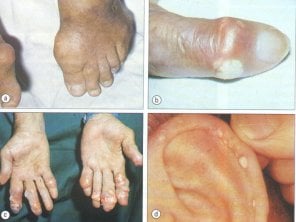
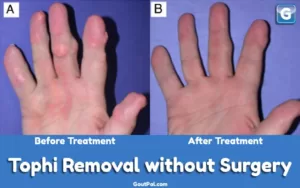
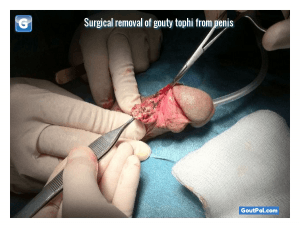
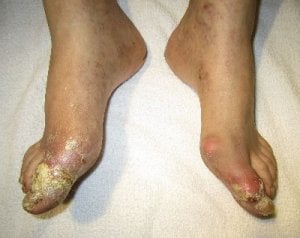
Gouty tophi are usually noticed under the skin, and are not usually painful until they burst through the skin, or become infected.

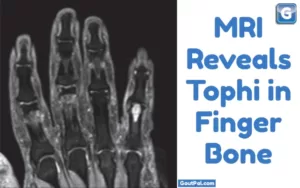
Gouty Tophi In Bone Image

Gouty Tophi In Bone

We tend to ignore them in the early stages, and concentrate more on relieving the pain from acute gout flares.

But is this wise?

Probably not now that technology allows us to see tophi growing into cartilage, tendons and bones, leading to bone erosion and severe, painful, joint damage.

Gouty Tophi & Bone Erosion Revealed

It has been a few years since improvements in scanning techniques allowed us to view what is happening inside joints. Over 3 years ago, I quoted from Dalbeth [1]:

There is a strong relationship between bone erosion and the presence of intraosseous tophus. These results strongly implicate tophus infiltration into bone as the dominant mechanism for development of bone erosion and joint damage in gout.

Gouty Tophi & Bone Erosion Reviewed

A significant part of Dalbeth’s, and related research, is the observation that DECT reveals urate deposits much more effectively than any other technique, to the point that joints often show uric acid deposits prior to any physical or inflammatory indication of gout.

There is a commonly held belief that asymptomatic hyperuricemia (high uric acid with no gouty arthritis symptoms) does not need to be treated. This DECT research prompts me to believe that this policy needs to be reconsidered. As I said in my DECT review earlier this year [2]:

Lowering uric acid is more important than generally recognized. The policy of waiting for
several acute gout attacks before commencing urate lowering therapy is outdated, especially
given these clear indications that tendon damage takes place prior to acute gout flares.

Fortunately, this view is beginning to change amongst the more enlightened members of the rheumatology profession. Black and colleagues [3] note:

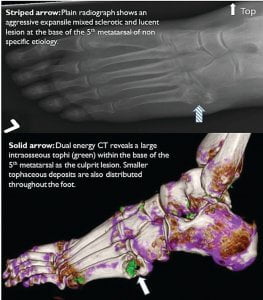
Urate Deposits DECT Image

3D reconstruction clearly conveys uric acid quantity and distribution.


Utilization of imaging studies in order to accurately diagnose, monitor progression or treatment response, and assess clinical outcomes is increasing rapidly

Black’s review includes additional investigation showing benefits in over 50 cases. Note that this study has the diagnostic software to show urate deposits in green, rather than the red selected by most investigators. Many of their cases show clear diagnosis through DECT where traditional techniques have failed.

However, they do add a cautionary note:

Limited initial availability will likely continue the role of DECT to those individuals with diagnostic uncertainty or access to larger imaging centers.

Gouty Tophi & Bone Erosion Restrained

Perhaps the cautionary note is contagious.

It is disappointing to see that whilst recent professional advice recognizes the value of DECT it fails to acknowledge it’s importance as a diagnostic technique, and fails to recognize the implications on asymptomatic hyperuricemia.

Schumacher & Weaver [4] give with the one hand…

Recent studies show that DECT scans reveal signifcantly more areas of urate deposition than a physical examination. [...] But if these newer imaging techniques can identify MSU crystal deposition prior to bone erosion or joint destruction, they offer promise as a noninvasive alternative for diagnosing gout in the earliest stages of the disease. In addition, they may be used in the future to monitor the progression of gout and the effectiveness of ULT.

… but take with the other:

The consensus standard of care today is that asymptomatic hyperuricemia should not be treated.

Perhaps there will come a day when DECT, and other imaging techniques are common enough to dispel the myth that high uric acid is only dangerous when accompanied by acute gout flares. Until then, I recommend you do all you can to maintain your uric acid at a safe concentration below 6.5mg/dL (0.4 mmol/L).


Gouty Tophi & Bone Erosion References

  1. Title: Mechanisms of bone erosion in gout: a quantitative analysis using plain radiography and computed tomography. Authors: Dalbeth N, Clark B, Gregory K, Gamble G, Sheehan T, Doyle A, McQueen FM. Published: Ann Rheum Dis. 2009 Aug;68(8):1290-5.
  2. Title: DECT For Gout Diagnosis Author: Keith Taylor (GoutPal.com)
  3. Title: Dual-Energy Computed Tomography for the Evaluation of Gout and Calcium Crystal Deposits. Authors: Black DF , Glazebrook K , Bongartz T , Matteson EL , Manek NJ , Leng S , Fletcher JG, McCollough C. File: Gouty Tophi Revealed With DECT
  4. Title: Core Principles in the Diagnosis and Management of Gout and Hyperuricemia. Authors: Schumacher HR, Weaver AL. File: Gout And Hyperuricemia

Uric Acid Back Pain: The Heavy Load Of Gout

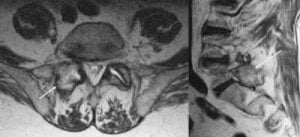
Uric Acid Back Pain ImageA new report on uric acid and back pain reminds me of the critical consequences of failure to manage gout properly.

Are you the type of macho man who wants to avoid daily uric acid treatment because you can stand the agony of a swollen big toe?

You might think again when your back is crippled and you can no longer stand upright.

I’m not one for scaremongering, but I do get frustrated by people who suffer years of gouty agony because they refuse to control uric acid. OK, so painkillers can mask the pain, but they cannot stop the inevitable invasive growth of uric acid deposits.

The big toe is the most common joint to get affected, but if left untreated, high uric acid levels will lead to urate deposits in every joint. This is more than a painful nuisance – these uric acid deposits known as tophi eat into bone, cartilage, and tendons causing permanent joint damage.

Most of us are lucky enough to live in a society where joint reconstruction surgery is a possibility, but why put yourself at that risk?

And I did mention every joint. Foot gout is a common problem because there are lots of joints in the foot. There are also lots of joints in the spine, and gout in the back, though fairly uncommon, is serious enough for you to be very afraid.

In gout management, there is too much emphasis on short term pain relief, and insufficient awareness of the consequences of allowing gout to reach the tophaceous stage. A single tophus (the name given to uric acid crystals when they form a lump in the body) often means severe joint movement restriction. This is quite common on the hands, where groups of tophi (the plural of tophus) tend to restrict finger movement. When this happens in the spine, back movement restriction becomes critical, and total incapacity from spine distortion is a real risk.

Samuels and colleagues reported a particularly bad case of spinal gout in the June issue of Bulletin of the NYU Hospital for Joint Diseases[1]. The image above shows how tophi in and around the spine have severely distorted the patient’s back. The report reveals that this impaired the ability to stand long enough to take a shower.

Fortunately, the patient responded well to allopurinol, even though he required a dose of:

750 mg daily to achieve a target serum uric acid level less than 6.0 mg/dL.

As I mentioned, uric acid back pain in the form of tophaceous spinal gout is uncommon, but the Samuels report does manage to cite 7 other cases, and there will be many more that go unreported.

It really is not worth letting gout go untreated this long. Are you showing any symptoms of tophaceous gout, or indeed gout symptoms of any kind, such as swollen joints? If so, you need to get your uric acid level checked by your doctor, and controlled today.


Uric Acid Back Pain References

  1. Authors: Jonathan Samuels, M.D., Robert T. Keenan, M.D., M.P.H., Rena Yu, M.D., Michael H. Pillinger, M.D., and Tibor Bescke, M.D. Title: Erosive Spinal Tophus in a Patient with Gout and Back Pain. Published: June 2010.

Lower Uric Acid Gives Faster Gout Cure

Your gout symptoms clear faster with lower uric acid, but how low should you go?

Tophi Shrink Fast With Low Uric Acid

It is very difficult to measure how fast old uric acid crystals are dissolving, but for chronic tophaceous gout sufferers, we can measure how fast their tophi shrink.

Allopurinol for gout has been around for 40 years, and febuxostat is the latest weapon in a growing list of medicines that will lower uric acid. But still people are unsure how low they need to go.
(more…)