2010 Gout Blog

The Fast, Full & Fresh Gout Blog

GoutPal’s 2010 gout blog celebrates 5 years of gouty arthritis help, advice and news.

Your Gout Blog

GoutPal will help with your gout diet, give advice about gouty symptoms, and tell you about new treatments for uric acid problems.

This blog is your place for gout news. Not just news about the latest treatments and remedies, but all new information that affects gout sufferers and their carers. It includes:

  • New ways to get gout help
  • New information to understand gout
  • New guidelines distilling the ever-increasing knowledge-base built by the GoutPal community.

This blog introduces you to new information in key gout sections:

Read the rest of this entry »

Uric Acid Back Pain: The Heavy Load Of Gout

Uric Acid Back Pain ImageA new report on uric acid and back pain reminds me of the critical consequences of failure to manage gout properly.

Are you the type of macho man who wants to avoid daily uric acid treatment because you can stand the agony of a swollen big toe?

You might think again when your back is crippled and you can no longer stand upright.

I’m not one for scaremongering, but I do get frustrated by people who suffer years of gouty agony because they refuse to control uric acid. OK, so painkillers can mask the pain, but they cannot stop the inevitable invasive growth of uric acid deposits.

The big toe is the most common joint to get affected, but if left untreated, high uric acid levels will lead to urate deposits in every joint. This is more than a painful nuisance – these uric acid deposits known as tophi eat into bone, cartilage, and tendons causing permanent joint damage.

Most of us are lucky enough to live in a society where joint reconstruction surgery is a possibility, but why put yourself at that risk?

And I did mention every joint. Foot gout is a common problem because there are lots of joints in the foot. There are also lots of joints in the spine, and gout in the back, though fairly uncommon, is serious enough for you to be very afraid.

In gout management, there is too much emphasis on short term pain relief, and insufficient awareness of the consequences of allowing gout to reach the tophaceous stage. A single tophus (the name given to uric acid crystals when they form a lump in the body) often means severe joint movement restriction. This is quite common on the hands, where groups of tophi (the plural of tophus) tend to restrict finger movement. When this happens in the spine, back movement restriction becomes critical, and total incapacity from spine distortion is a real risk.

Samuels and colleagues reported a particularly bad case of spinal gout in the June issue of Bulletin of the NYU Hospital for Joint Diseases[1]. The image above shows how tophi in and around the spine have severely distorted the patient’s back. The report reveals that this impaired the ability to stand long enough to take a shower.

Fortunately, the patient responded well to allopurinol, even though he required a dose of:

750 mg daily to achieve a target serum uric acid level less than 6.0 mg/dL.

As I mentioned, uric acid back pain in the form of tophaceous spinal gout is uncommon, but the Samuels report does manage to cite 7 other cases, and there will be many more that go unreported.

It really is not worth letting gout go untreated this long. Are you showing any symptoms of tophaceous gout, or indeed gout symptoms of any kind, such as swollen joints? If so, you need to get your uric acid level checked by your doctor, and controlled today.


Uric Acid Back Pain References

  1. Authors: Jonathan Samuels, M.D., Robert T. Keenan, M.D., M.P.H., Rena Yu, M.D., Michael H. Pillinger, M.D., and Tibor Bescke, M.D. Title: Erosive Spinal Tophus in a Patient with Gout and Back Pain. Published: June 2010.

Food High In Uric Acid: The Mythical Beast That Still Haunts Gouties

Back in the mists of time (OK – 5 years ago), I began my quest for food high in uric acid.

Sages spoke of the Land Of Plentiful Purines where gouties were banished to live out their days in exquisite swollen torture.

Then, came wise men from the East proclaiming that all was not as it seemed in GoutWorld…

To put it another way.

When most medics practicing today were in med school, the dietary control of gout was very simple: no high purine foods; limited medium purine foods; and unlimited low purine foods.

Then research in the 1970s and 80s began to question the simplicity of this view. In 1985, Zöllner[1] noted:

purine sources differ in their absorption rates, a fact not taken into account in our food tables.

[...] In summary it can be concluded that dietary purines are absorbed to a variable extent, depending on the degree of hydrolysis to nucleosides and/or nucleotides, and that they are oxidized to uric acid in the gut and excreted as uric acid, which is bad for gout but without influence on purine metabolism.

He concludes:

Supplements of dietary purines produce dose-proportional increases in plasma uric acid concentrations, uric acid pool size and renal uric acid excretion. The magnitude of these increases depends on the type of purine compound administered, which may limit the value of food tables for human dietetics. Purine content of food must be related not only to weight but also to energy and to protein, particularly if new foodstuffs or a vegetarian diet are ingested.

It is worth noting at this point, that foods never contain uric acid. Many do contain purines, which are a source of uric acid, but as Zöllner points out, there are different type of purine, and they metabolize to uric acid at different rates. He also points out that we do not really need to digest purines for uric acid, as we can make our own by reprocessing dead cells.

A turning point in our understanding of food high in uric acid came about in 2004. Choi and colleagues compiled statistics from a 12 year study of over 40,000 men. Though this statistical review adds nothing to our knowledge of how different purines affect gout in different ways, it certainly changed the way gout experts view diet.

Their conclusions set the foundation for today’s more effective gout diet plans:

Higher levels of meat and seafood consumption are associated with an increased risk of gout, whereas a higher level of consumption of dairy products is associated with a decreased risk. Moderate intake of purine-rich vegetables or protein is not associated with an increased risk of gout.

Though not the total story, as they do not factor in risks such as obesity and excess iron, those words should be tattooed on the hearts of all gout nutritionists. My simple view of purine control is to balance small portions (up to 4 oz) of meat or fish with low-fat dairy products. Fill the plate with whatever vegetable foods you enjoy. Simple and effective.

Finally, though we can see that some form of purine control may help gout, it is absolutely pointless to attempt this if you do not monitor your uric acid numbers. There is no correlation between gout pain and purines. You might still experience gout pain when uric acid is lowering because old urate crystals can cause a gout reaction before they dissolve completely. Make sure that you know and understand your uric acid level.


Food High In Uric Acid References

  1. Author: Zöllner N . Title: Purine and pyrimidine metabolism. Published: Sep 1985.
  2. Authors: Hyon K. Choi, M.D., Dr.P.H., Karen Atkinson, M.D., M.P.H., Elizabeth W. Karlson, M.D., Walter Willett, M.D., Dr.P.H., and Gary Curhan, M.D., Sc.D. Title:Purine-Rich Foods, Dairy and Protein Intake, and the Risk of Gout in Men . Published: March 2004.

See more articles related to food high in uric acid in the Gout Diet section.

What Is Uric Acid? Vital Friend Or Deadly Foe?

I get asked every day, “What is uric acid?”

Chemically, it is a very weak organic acid, but that does not help you understand it, or it’s relationship with gout.

Medically, it is thought to be vital to our health, and our ability to stand upright.

But our uric acid control mechanisms are complicated, and if it gets out of balance, high uric acid leads to gouty arthritis. And worse.

The American Society for Clinical Investigation has recently reviewed the purpose of uric acid and it’s relationship with gout and other diseases.

“Uric acid transport and disease”[1] introduces its review with reference to the role of uric acid in evolution[2]. Humans have much higher levels of uric acid than many other animals because we no longer produce uricase naturally, which reduces uric acid to allantoin.

In other articles, I look at allantoin; how bacteria in our guts retain the ability to reduce uric acid; and how new drugs like rasburicase (sold under the Elitek brand) and peglioticase (sold under the Krystexxa brand) can reintroduce uricase to our bodies.

Here, I focus on what uric acid is. The report continues with some of the known benefits of uric acid.

Uric Acid: Vital Friend

The uric acid review highlights benefits of uric acid[3] including:

  • Powerful antioxidant properties
  • Fights heart disease
  • Fights cancer
  • Extends lifespan

Of course, these benefits are not always without consequences. We are aware that uric acid probably plays a part in raising blood pressure in order to walk upright, but this relies on several processes in our bodies to produce uric acid from dead body cells. These can be our own cells, or animal cells that we eat.

Our kidneys try to regulate the uric acid concentration in our blood. They filter out uric acid, then release back enough to maintain our vital functions. When systems go out-of-balance, complex factors can interact to cause problems in other areas. Often, we can see statistical associations with other diseases and conditions even though the causal links are not yet clear.

Uric Acid: Deadly Foe

The uric acid review continues to describe problems with high uric acid levels. This condition, known as hyperuricemia, is associated with several problems including:

  • High blood pressure
  • Heart disease
  • Metabolic syndrome (a combination of diabetes or high blood pressure or obesity with heart disease or stroke or other blood circulation problems)

This of course is in addition to the problems directly associated with gout, discussed at length throughout this site, including:

  • Kidney inflammation and stones.
  • Bone, cartilage, and tendon destruction.

The report continues with a summary of emerging genetic investigation. I will review this area of gout research separately, as it addresses the “Why” rather than “What” of uric acid.

Next Steps To Answer “What Is Uric Acid?”

You’ve learned that uric acid is a component of our blood that is vital to human health, but destructive when we have too much. This is why you must control it to avoid serious longterm health problems, and not simply relieve gout pain.

You can learn more about the properties of uric acid and how it affects gouty arthritis in the “Understanding Uric Acid & Gout” section.


References For “What Is Uric Acid?”

  1. Author: So A, Thorens B. Title: Uric acid transport and disease. Published: J Clin Invest. 2010 Jun 1;120(6):1791-9.
  2. Author: Oda M, Satta Y, Takenaka O, Takahata N. Title: Loss of urate oxidase activity in hominoids and its evolutionary implications. Published: Mol Biol Evol. 2002 May;19(5):640-53.
  3. Author: Ames BN, Cathcart R, Schwiers E, Hochstein P. Title: Uric acid provides an antioxidant defense in humans against oxidant- and radical-caused aging and cancer: a hypothesis. Published: Proc Natl Acad Sci U S A. 1981 Nov;78(11):6858-62.

High Uric Acid And Kidney Disease

A new report studying high uric acid and kidney disease confirms earlier indications of the dangers of hyperuricemia revealed by the 2008 Austrian investigations.

High Uric Acid & Kidney Disease Image

In a study investigating the “Association between serum uric acid and early kidney damage in middle-aged and elderly”, Chinese scientists show a clear correlation between high uric acid in the blood and reduced kidney function.

Though this new report[1] adds nothing to the Austrian study[2] in terms of understanding why elevated uric acid leads to kidney impairment, it does confirm that the two are linked. It certainly adds weight to my position that asymptomatic hyperuricemia should be taken much more seriously.

High Uric Acid And Kidney Disease Investigation

The following information is extracted from the abstract of the uric acid investigation: “Association between serum uric acid and early kidney damage in middle-aged and elderly.”

Uric Acid Investigation Objectives

To investigate the association between uric acid in the blood and early kidney damage. Also investigate the prevalence of early kidney damage in the middle-aged and elders with normal serum creatinine.

Uric Acid Investigation Methods

The investigation surveyed 1023 subjects from the local population of Chengdu in China. The study group comprised of 539 men and 484 women aged between 57 and 69, selected randomly from the population with normal serum creatinine.

Subjects were divided into 4 groups determined by uric acid level in the blood:

  1. Less than 4.74 mg/dL (0.282 mmol/L)
  2. 4.74 mg/dL to 5.56 mg/dL (0.331 mmol/L)
  3. 5.56 mg/dL to 6.37 mg/dL (0.379 mmol/L)
  4. Greater than 6.37 mg/dL

Clearly not gout sufferers, but this is about uric acid, not necessarily gouty arthritis. The survey looked at cardiovascular risk factors, including serum UA and estimated glomerular filtration rate (eGFR) using the MDRD (modification of diet in renal disease) equation.

Uric Acid Investigation Results

Overall, 28.1% of subjects had early kidney damage, with men, at 35.8%, much more susceptible than women at 19.5%. The incidence of early kidney disease was analyzed to calculate the odds ratio across each of the 4 study groups. Taking the value of group A as 1, the other groups show the following risks:

  1. 1.0
  2. 1.740
  3. 3.599
  4. 5.488

Uric Acid Investigation Conclusion

The investigation concludes:

In the middle-aged and elders with normal serum creatinine, serum UA and eGFR are negatively correlated. And serum UA level is independently associated with early kidney damage.

GoutPal Conclusion

Given that the earlier study showed that uric acid levels above 9 mg/dL are associated with triple the incidence of kidney disease compared to below 7mg/dL, then any uric acid level above 5mg/dL suggests cause for concern.

Neither of these studies have shown whether high uric acid impairs kidney function or if kidney disease caused by something else causes uric acid levels to rise. Given that Siu and colleagues have shown allopurinol to be beneficial for kidney disease sufferers[3], I reckon there are good grounds to suggest that lowering the uric acid will lower the risk of kidney disease. As ever, this are cries out for more specific research. If you find some, please share it with the world on the gout forum.


High Uric Acid And Kidney Disease References

  1. He S, Chen XP, Jiang LY, Peng Y, Gong L, Chen XN, Wu K, Cui KJ, Zhu Y, Huang DJ. [Association between serum uric acid and early kidney damage in middle-aged and elderly]. Zhonghua Yi Xue Za Zhi. 2010 Mar 16;90(10):658-61. [Article in Chinese]
  2. Obermayr RP, Temml C, Gutjahr G, Knechtelsdorfer M, Oberbauer R, Klauser-Braun R. Elevated uric acid increases the risk for kidney disease. J Am Soc Nephrol. 2008 Dec;19(12):2407-13. Epub 2008 Sep 17.
  3. Siu YP, Leung KT, Tong MK, Kwan TH. Use of allopurinol in slowing the progression of renal disease through its ability to lower serum uric acid level. Am J Kidney Dis. 2006 Jan;47(1):51-9.

Alkaline Foods: More Myths Exposed

Alkaline foods raise more controversy than they are worth.

People swear they are the holy grail of health – a magic cure for gout and every other health problem in the world.

Skeptics swear back: “You’re wasting your *#@!$&! time.

It’s time for us to see the real truth behind alkaline diet and gouty arthritis.

Myth 1: Alkaline Foods Turn Red Litmus Blue

Alkaline Foods Image

Alkaline Foods Image

Despite my best efforts to explain otherwise, people still believe that you can measure the power of alkaline foods by testing their pH. There are even lists of alkaline foods touted round the Internet that show the pH value for common foods. But these have nothing to do with the alkalizing effect, so why do they exist?

They stem from a US government table of pH values produced for the canning industry. Whilst they might help food packagers determine what balancing agents they need to avoid food reacting with it’s container, these values have absolutely nothing to do with the effect of food on our bodies.

The science of alkaline foods recognizes that elements and compounds in food cause different reactions in our body when digested. Some elements, e.g. proteins and phosphorous produce acidic salts. Other elements, e.g. potassium, magnesium and calcium, produce alkaline salts. These salts end up at our kidneys, where they alter the pH environment. This process has resulted in the Potential Renal Acid Load (PRAL) calculation, which is an approximate estimate of the effect of foods on the acidity/alkalinity of our bodies. Or more specifically, of urine, as this is the measurable result.

Still, people remain confused as to how an acidic food item, like lemons or vinegar, can have an alkalizing effect on urine and the kidneys. As I explained recently: Read the rest of Alkaline Foods: More Myths Exposed

Uric Acid Crystals: Time To Dissolve

Uric acid crystals must be dissolved to permanently get rid of gout pain, but how long does it take to get rid of them?

Time To Dissolve Uric Acid Crystals

Like all gouty issues, the answer is never simple. However, we can see some factors that affect the time it takes for crystals to dissolve, and see that the time to start dissolving is now.

In an earlier article, I explained how tophi shrink quicker with lower uric acid concentrations. But this does not mean that once you lower uric acid to a safe level you will immediately stop all gout attacks. In fact, partially dissolved uric acid crystals can start a gout attack, as I explained in Allopurinol Medication: Why It Hurts To Get Rid Of Gout. Though that article looks specifically at allopurinol, the effects of dissolving uric acid crystals might occur with any urate lowering treatment, including diet, until all urate deposits dissolve. But how long does this cleansing period take?
Read the rest of this Uric Acid Crystals article…

Normal Uric Acid Blood Test? No Thanks!

The uric acid blood test is what warns us gouties that we are at risk of another acute gout attack.

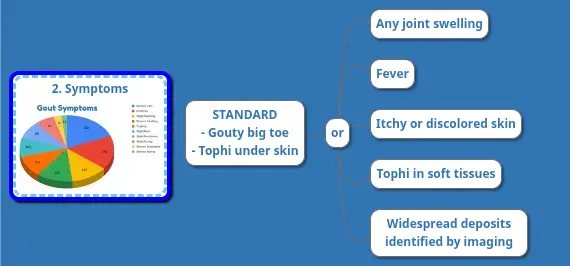
Gout Symptoms

Gout symptoms but no gout diagnosis? See how a normal uric acid blood test can be unreliable:

This is very reliable for confirmed gout patients, but a source of extreme confusion and frustration for unconfirmed patients with gout symptoms.

Uric Acid Diagnosis Vs Uric Acid Management

There is a significant difference in interpreting uric acid blood test results between confirmed and suspected gout cases. For a confirmed gout patient, any number above 7mg/dL (0.4 mmol/L) is a clear risk of a gout attack. Blood tests for confirmed gouties should be used as an aid to managing gout. They indicate whether urate lowering therapy is set at the right dosage. This is a fairly simple process, though it does rely on the doctor understanding the need to set the right target uric acid level, and it relies on the patient taking the medication daily as directed.

The problems arise when a gout diagnosis is doubtful, and uric acid blood test results are being used to help form a definite diagnosis. There are two fundamental problems with this approach, which I explain below. Gout diagnosis from blood tests is possible, but needs a clear understanding of the gout process, preferably bolstered by more tests on a weekly basis.

We know that uric acid crystals can form in joints at normal temperatures with a uric acid concentration of slightly under 7mg/dL [1]. For confirmed gout patients, it is almost certain that uric acid will form crystals at that level. For unconfirmed gout patients, there is a strong probability that it will cause a gout attack, but this is not certain.

Uric Acid Blood Test Reporting Problem

Read the rest of this entry »

Gout And Acupuncture

Prompted by the suggestion that acupuncture might help the itching associated with gout, I conducted a little research into acupuncture and gout, with surprising results.

Recent research suggests that various forms of acupuncture might help gout sufferers in different ways.

Acupuncture is commonly viewed as sticking needles into various parts of the body. Though needles are often involved, the aim is to stimulate energy flow in the body, and so other related techniques are often grouped under the acupuncture umbrella.

A detailed study of acupuncture is beyond the scope of this gout website, however I would like to draw your attention to 3 studies reported last year. Read the rest of this entry »

The GOUT Fix

I read thousands of words everyday about gout. The complexities are endless, whether you look at causes, diagnosis, or treatment.

I’m reminded of the best piece of advice I learned in the complex world of business, finance, and Information Technology.

K.I.S.S. Keep It Simple Stupid.

Gout is complicated. Fixing gout is simple.

Do not start with the herbal mixture, and explain how you are sort-of-cured, but not quite.

Do not start with the allopurinol itch, and explain how your gout would be fixed if only you took the meds every day.

Do not hide behind food obsessions, and explain how gout never troubles you if you can only avoid purines.

Get a plan, and focus on fixing your gout. Let me help you focus on G.O.U.T.

The ⒼⓄⓊⓉ Plan To Fix Gout

Read the rest of this entry »

Devil Claw: Gout Sufferers Beware

Devil Claw, also called Devil’s Claw, is often sold as a treatment for various forms of arthritis, including gout.

The herbal gout treatment is extracted from the secondary roots of the Devil’s Claw plant (Harpagophytum procumbens).

As far as I can see, there have been no studies of Devil Claw & gout. However, a number of studies have looked at the anti-inflammatory properties. I have summarized 3 studies below.

Read the rest of this entry »

The menu on the left will take you to other gouty pages.
As you move around the menu, this message will change to tell you what the page is about.