Potential Renal Acid Load (PRAL) is a calculated value that estimates how foods might change acidity or alkalinity of the body.
PRAL is a precise calculation from 5 nutrient values in food, but it is not an exact measure. It is a shortcut measure to assess the effect of foods on the pH of the body.
When you are planning a gout diet menu, you need to include a wide range of foods. This ensures that you get enough different nutrients to be healthy. It also ensures that the menu is interesting, and can include your favorite foods. The menu must include some acid producing foods, but a good gout menu is a balanced menu.
PRAL For Gout Sufferers
PRAL is a widely used tool for estimating the acid load on your kidneys. This is the general pH level derived from many different compounds, not uric acid.
PRAL is not a measure of uric acid, but a higher pH makes uric acid more soluble. This means that crystals are less likely to form.
It is important to realize that pH of blood is tightly regulated by our body, and so following an alkalizing diet is not likely to have a dramatic effect on gout. However, an alkalizing diet is widely recognized as promoting good general health. For gout sufferers at risk of kidney stones, an alkalizing diet is very effective in preventing or dissolving uric acid kidney stones.
This happens because an alkalizing diet leads to alkaline urine. This creates the right conditions to stop uric acid forming kidney stones. As of 2012, there is some evidence that this may also improve uric acid excretion. This requires further study. I will monitor the investigations into the effects of an alkalizing diet on uric acid and gout.
What Is Potential Renal Acid Load?
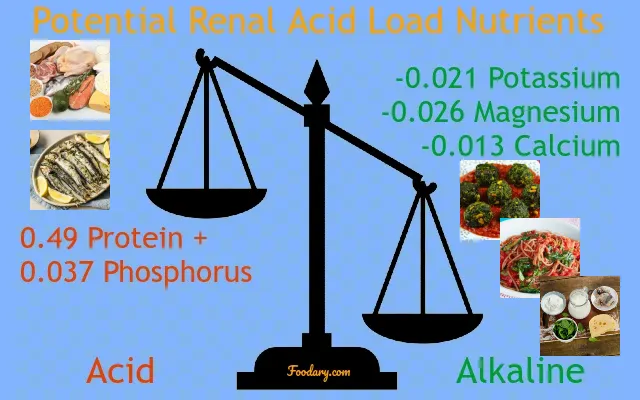
Potential renal acid load experiments show that PRAL is a reliable approximation of the pH effect of foods. It is calculated from:
- PRAL =
- 0.49 Protein + 0.037 Phosphorus
– 0.021 Potassium – 0.026 Magnesium – 0.013 Calcium
Acid forming foods have a positive range, alkaline forming foods have a negative range. For adequate nutrition it is important to choose a combination of foods with positive and negative PRAL values. You need some acid forming foods, but you must balance these with sufficient alkaline forming foods to give an overall negative total. As far as I know, there is no target value to aim at.
Your target is really to increase the pH of urine, so frequent testing will show if you need to improve your PRAL score.
As PRAL is more about nutrition than gout, I have moved my tables of individual food items to my Science of Eating Patterns, Illness, and Wellness website. There you can analyze your total diet, and then see which food items you should change to improve your gout diet.
Potential Renal Acid Load In A Gout Diet Menu
When you are planning a gout diet menu, the first principle is balance. I.e. you balance acid producing foods with a greater portion of alkalizing foods. I suggest you change this gradually. Your initial target should be 30% acid to 70% alkali. You can do this over several weeks, or all at once, depending on how you feel about dieting.
Please remember that PRAL is just a guide to foods that have alkaline or acid effects. The true measure depends on other factors and must be monitored by testing urine with pH strips. The best approach is to test now, introduce your 30/70 gout diet menu, then test again to assess your improvement.
Your target pH will vary according to your circumstances, but the use of PRAL charts is always the same. Use them to assess your acid/alkali balance, and use them to improve the ratio of alkali to acid in your gout diet menu. Never set a PRAL target.
Your target is your urine pH, and Potential Renal Acid Load tables are one tool that you can use to help you achieve your target. See the Gout Diet Menu pages for more explanation.
Leave the Potential Renal Acid Load page to read other aspects of an Alkalizing Gout Diet Menu.
Potential Renal Acid Load Related Topics
Please remember: to find more related pages that are relevant to you, use the search box near the top of every page.
Common Terms: alkaline, Most Helpful Gout Pages, PRAL
Other posts that include these terms:
- High Alkaline Foods for Gout Diet Menu
- Gout Foods Table for Vegetables
- Gout Food List for GoutPal Foodies
- Foods High in Uric Acid Chart
- Purine Rich Foods
- Does Alcohol Affect Gout?
- Colchicine For Gout
Please give your feedback
Did this page help you? If yes, please consider a small donation. Your donations help keep GoutPal's gout support services free for everyone.
If not, please tell me how I can improve it to help you more.